Filipinos in South Korea

Supreme Court and Sandiganbayan orders turnover of Marcos' looted $42 Million USD to Philippine Treasury

Bank of America Merrill Lynch - Photo: investmentnews.com

Court orders turnover of Marcos' USD42M loot to govt

MANILA - The Sandiganbayan has ordered the turnover to the government of 42 million US dollars in the so-called "Arelma" account of the late dictator Ferdinand Marcos.

The anti-graft court's Special Division issued a two-page writ of execution on the 18th of this month directing the transfer of the money from the Philippine National Bank to the Bureau of Treasury.

The funds represent Marcos assets, originally amounting to 2 million dollars deposited with Merrill Lynch Securities in New York in 1972 in the name of Arelma Foundation.

The order was based on a Supreme Court ruling dated March 12, 2014.

In the ruling, the High Court junked the motion for reconsideration filed by Imelda Marcos, on behalf of the late President, and affirmed its April 25, 2012 decision which held that "[a]ll assets, properties, and funds belonging to Arelma, S.A., with an estimated aggregate amount of $3,369,975 as of 1983, plus all interests and all other income accrued thereon" be forfeited in favor of government when these assets are transferred to the possession of the Republic of the Philippines.

The case stems from a petition for forfeiture filed by the Presidential Commission on Good Government (PCGG) with the Sandiganbayan on Dec. 17, 1991 involving $356 million ($658 million as of the April 2012 SC ruling), and two treasury notes worth $25 million and $5 million, allegedly illegally amassed by the Marcoses.

The PCGG petition also sought the forfeiture of the assets of alleged dummy corporations and entities established by the Marcoses, as well as real properties and personal properties obtained by the couple "manifestly out of proportion" to their lawful income.

Sandiganbayan - photo: philippinechronicle.com

Arelma, which maintained an account and portfolio in Merrill Lynch, New York, was described by the PCGG in the petition as among entities purportedly organized by the Marcoses for "hiding ill-gotten wealth."

The PCGG stressed that the Marcoses could not have afforded to acquire Arelma because their combined lawful income for the period 1966 to 1986, or in the two decades they were in power, was only P2,319,583 or $ 304,372, or only 9% of the entire Arelma fund of $3.4 million in 1983.

The PCGG obtained a favorable ruling from the Sandiganbayan on April 2, 2009; the anti-graft court declared all assets and properties of Arelma, S.A. forfeited in favor of the government.

The Marcoses filed an appeal with the SC to seek a reversal of the Sandiganbayan ruling.

In its 2012 decision, the high court stressed that "in determining whether the presumption of ill-gotten wealth should be applied, the relevant period is incumbency, or the period in which the public officer served in that position."

"The amount of the public officer's salary and lawful income is compared against any property or amount required for that same period," the high court said.

In its final ruling, the high court said the arguments the Marcoses raised in their MR were already passed upon in the 2012 decision.

Marcos incorporated Arelma, S.A. under Panamanian law in 1972, he was already President then; in 2000, the account had grown to $35 million. - ABS-CBN News
 

Charter Change (Cha-Cha) Kicks Off! Should Pro Win? Aquino could have 2nd Term?


Cha-cha gets going

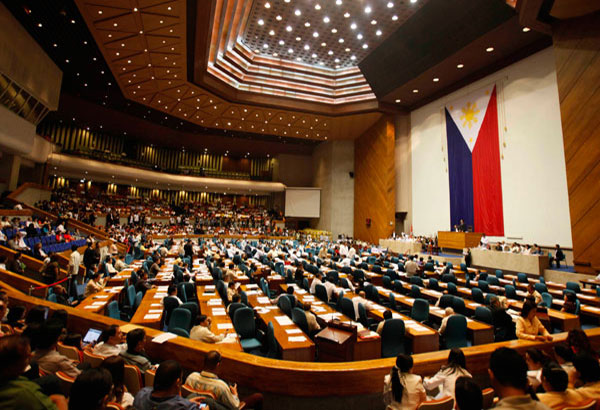
MANILA, Philippines - Floor debates over proposals to change economic provisions of the Constitution kicked off at the House of Representatives yesterday, with one of the proponents stressing that the effort is more about making future economic legislation responsive to Filipinos’ needs than giving foreigners the right to own land.

Davao City Rep. Mylene Garcia-Albano, who chairs the committee on constitutional amendment, made this clear in response to interpellation of Resolution of Both Houses No. 1 (RBH 1) by Akbayan party-list Rep. Walden Bello.

The plenary debates ended at past 7 p.m.

Albano said any proposed amendment to economic provisions of the Constitution would not be automatically written and adopted even if the resolution being discussed in the House is approved and ratified by the people.

Albano was the first to defend RBH 1 yesterday.

RBH 1, principally authored by Speaker Feliciano Belmonte Jr., seeks to include the phrase “unless otherwise provided by law” in some sections of Articles XII (national economy and patrimony), XIV (education, science and technology, arts, culture and sports) and XVI (general provisions).

This means the constitutional restrictions on foreign ownership will remain until Congress enacts specific laws to remove them.

In his interpellation, Bello pointed out that China, Indonesia and Vietnam have the same constitutional restrictions on foreign ownership of land but these did not hinder the massive flow of foreign investments to their economies.

“We have seen that in the most dynamic economies in Southeast Asia, constitutional ban on foreign ownership was not in fact a hindrance – it’s something that foreign investors have learned to live with,” Bello said.

Albano, however, pointed out that RBH 1 does not contemplate on directly writing amendments to the Constitution but only seeks to allow the country to adjust or adapt to future economic realities and contingencies.

She said the parliaments of China, Indonesia and Vietnam have passed numerous laws that tend to ease economic restrictions in their respective constitutions.

“That’s not the objective. We’re not saying we’re going to remove them (restrictions). We want to provide flexibility to our country on crafting economic policies to meet the exigencies that come our way,” Albano told Bello.

She said China has allowed long-term lease of up to 99 years for land, while Vietnam and Indonesia have also enacted laws that allow full repatriation of earnings of investors, among other legislation passed to attract investments.

Albano said land ownership is not the only concern addressed by RBH 1, but also other sectors and aspects of the economy.

She noted Congress recently ratified a bill allowing full foreign ownership of banks.

Leaders of the chamber said they would try to speed up passage of RBH 1 to protect it from possible attempts by some lawmakers to dilute it with proposals to amend the political provisions of the Constitution to allow President Aquino to seek another term.

A counterpart measure, authored by Sen. Ralph Recto, is pending in the Senate.

Belmonte earlier expressed confidence that there would not be much fuss over RBH 1 as it is aimed at attracting investments and boosting employment.

“This is just a simple change. The door (to investments) is still locked and we have to provide a legal key,” the Speaker said. “I suppose all the countries around us, in fact, have always been ahead in the area of foreign direct investments, so we really have to start thinking on what we should do.”

He said positive economic developments and high foreign investor confidence provide further justification for removing constitutional obstacles to investments. - philSTAR


Philippine Economy likely grew over 6% in 2014 Q2 – FMIC


Economy likely grew over 6% in Q2 – FMIC


MANILA, Philippines - The country’s economy is forecast to expand by over six percent in the second quarter of 2014, slower than the 7.5-percent growth in the same period last year, according to First Metro Investment Corp. (FMIC).

Government forecasts gross domestic product (GDP) to grow between 6.5 to 7.5 percent this year.

In the first quarter of the year, the economy managed to expand a lower-than-expected 5.7 percent, as Super Typhoon Yolanda contributed to the poor performance.

But FMIC president Roberto Juanchito T.Dispo said clearer signs of recovery in the second quarter could serve as a positive momentum.

“We are quite confident that the economy will accelerate back towards the seven-percent growth part in the second half of 2014,” Dispo said. FMIC is a member of the Metrobank Group and one of the country’s leading investment firms.

He added that gains in industrial output look solid moving towards positive territory, employment growth at the start of the second quarter, and an anticipated momentum gain for government spending in the second semester of the year would get the Philippine economy back on track.

The FMIC executive said inflation is likely to accelerate in the third quarter to 4.8 percent or 0.5 percentage point higher than in the first three months of the year, due to the delayed importation of rice and the adverse impact on other food prices of Manila’s truck ban.

“We expect government spending to revert back to a 12-percent growth pace starting third quarter, with infrastructure spending continuing to lead the way,” Dispo said.

Exports are likewise seen to strengthen in the second semester as the US economy show solid signs of recovery with the help of speedier job creation. “China should continue to post seven-percent growth better for the second half, both adding to the demand for our export products,” the FMIC chief added.

The Bangko Sentral ng Pilipinas (BSP) is expected to raise policy rate by another 25 basis points (bps) and the reserve requirements by another 100 bps towards the end of the year.

FMIC said that corporate bond issuance should pick up for the rest of the second semester of 2014 as the large issuers in the market have reached the single-borrower limits (SBLs).

Meanwhile, the FMIC report cautioned that the equity market will have to absorb BSP’s tightening measures.

“Valuations remain stretched and the sustainability of valuations hinges on earnings catching up, or the economy continuing to register strong growth,” Dispo said, adding that poor first semester GDP growth would force a downward bias in revised economic forecasting.

Nonetheless, the investment firm believes that in the present state of the equity market remains positive as it continues to challenge the 7,100-level.

“With these in mind, we believe selectivity is key to outperformance and rotation to value and low beta plays are preferred. We continue to like banks due to M&A themes, potential re-rating catalyst, and gaming stocks with properties located at Entertainment City in Manila,” it added. - philSTAR

 
Investment Recommendation: Bitcoin Investments

Live trading with Bitcoin through SimpleFX Trading platform would allow you to grow your $100 to $1,000 Dollars or more in just a day. Just learn how to trade and enjoy the windfall of profits. Take note, Bitcoin is more expensive than Gold now.


Where to buy Bitcoins?

For Philippine customers: You could buy Bitcoin Online at Coins.ph
For outside the Philippines customers  may buy Bitcoins online at Coinbase.com