Filipinos in South Korea

Philippines vs Indonesia: Which is 'better' in Economic and Investment Aspects?

Which is winning the battle between the two rising economic stars?

It's been a close battle between Asia's two rising economic stars -- Philippines and Indonesia.

At first, Indonesia was edging ahead with its two investment grade status from Fitch Ratings in December 2011 and Moody's in January 2012.

But slowly and surely, the Philippines has crept up from behind, achieving its first investment grade rating from Fitch Ratings on March 27, and now its second from Standard and Poor's on May 2.

Philippines and Indonesia both have two investment grades from different credit rating agencies. Graphic by Matthew Hebrona/Rappler

Both countries, which are considered Asia's new tigers have been demonstrating strong economic growth against a sluggish global economy, almost catching up with Asia's other economic powerhouses, China and India.

So the tallies are even, but which one is really winning?

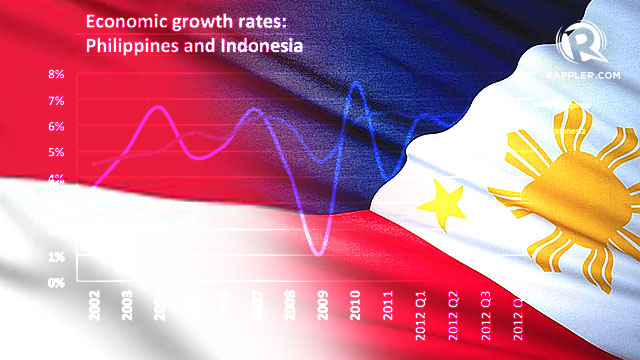
GDP growth

In terms of GDP growth, the Philippines has emerged a winner with a 2012 GDP faster rate of 6.6%.

Indonesia, on the other hand, saw its economy slow down after the government failed to reduce subsidies, which drained the government's finances, hurting the rupiah, resulting in lower foreign investor confidence. Indonesia grew at 6.23%.

On Monday May 6, Indonesia reported a first quarter 2013 growth of 6.02%, the slowest pace in more than two years. The Philippines is due to announce their first quarter results on May 30.

In the 3rd quarter of 2012, the Philippines recorded a growth of 7.1%, replacing Indonesia as the second-fastest in Asia next to China's 7.7% and the fastest in Southeast Asia. Indonesia, which dropped down to 3rd position, registered a growth of 6.2%.

The year 2012 saw a turning of tables for the Philippines. In 2011, the Philippines expansion of 3.9% was well below Indonesia's growth rate of 6.5% in 2011.

Aquino vs Bambang Yudhoyono

The promises of Presidents Susilo Bambang Yudhoyono in Indonesia and Benigno Aquino III in the Philippines to fight corruption, lower budget deficits, and bring in investment has won them both upgrades from Fitch Ratings and Moody's Investors Service in the past year.

Philippine President Aquino, who is halfway through a 6-year term, has been successful in increasing state spending and managing the budget deficit, while seeking more than $17 billion of infrastructure investments to spur growths.

The country's budget deficit has been brought down to 2% of gross domestic product (GDP) by 2012 from 3.9% when he took office in 2010. Aquino has also increased tax collections, passed the controversial sin tax law amendments, and ousted former Chief Justice Renato Corona in 2012 for illegally concealing his wealth.

Indonesian President Bambang Yudhoyono, who is in his final year in office, failed in 2012 to cut fuel subsidies, which have drained the government finances. This means the government has to find more funds to allocate to infrastructure spending.

According to the World Bank, the President Yudhoyono has said that his government is weighing the pros and cons of raising fuel prices or choosing another method that would more effectively target the subsidies at poorer consumers in a nation where almost one in 5 people lives on less than $1.25 a day.

Foreign investments

In this arena, Indonesia has the lead. The country has been attracting the second biggest chunk of foreign direct investments - $19.2 billion in 2012 - flowing into Southeast Asia, next to Singapore's $54 billion.

The Philippines on the other hand has remained a laggard, capturing only $1.5 billion in 2012.

Corruption Perceptions

The Philippines has the lead and is now seen as less corrupt than Indonesia. The Transparency International's Corruption Perceptions Index has boosted the Philippines' ranking to 105th place in 2012 from 139th in 2009, a year before Aquino became president.

Indonesia on the other hand was ranked 118th last year, slipping from 111th three years earlier.

As both rising stars diverge in their economic growth, it remains to be seen who will emerge the clear winner.

Investment destinations

To fund managers, however, both investment destinations remain attractive, and some don't even have to choose between the two.

Amid the economic woes, belt-tightening measures, gloomy outlook and credit rating downgrades in the west, most investment funds on the lookout for solid growth are eastward-bound.

A global fund manager told Rappler that the competition for investors' attention is not between Indonesia and the Philippines, but against other emerging economies in other regions, like Eastern Europe and South America. - with research from Ramon Calzado and Lean Santos

Rappler.com

Philippines Now Major Source of Skilled Migrates to New Zealand

Six of the seven Filipinos who work on Greg and Kelly Kirkwood's North Otago dairy farm are (from left) Neil Molina, Reis Pe, Eric George, Saldy Barroga, Roel Gonzales and Jeorge Barroga.Photo by Gerard O'Brien. Photo: Otago Daily Times

Filipinos have been migrating to New Zealand for the last 15 years and many New Zealand employers have become aware of their work ethics and skills. Many other countries around the world have been recruiting Filipinos for years because of their skills and their willingness to work in jobs that their local population has been unwilling to undertake. There is an increasing interest from New Zealand employers recently in hiring skilled migrant workers from the Philippines to fill the skills shortage in the local market.

For some years many hundreds of dairy farm workers have been employed by New Zealand farmers if they have been unable to find suitable staff locally. Today the NZ dairy farming industry has become dependent on Filipino workers to provide the labor force to meet their requirements of this rapidly growing industry. Many of the Filipinos coming to NZ have previously been working on commercial dairy farms in the Middle East or Japan, and have settled as residents with their families.

Over 11 million Filipinos work outside the Philippines. They can be found working around the world. Many Middle Eastern countries are dependent on their Filipino guest workers to keep their economies growing, where they work under contract for a certain number of years. Employers have recognized their willingness to work, their cheerful dispositions, and their ability to pick up language and new skills.

Before Filipinos can leave their country to work abroad they must obtain an Overseas Employment Certificate from the Philippines Overseas Employment Agency (POEA). Without this they cannot depart though many thousands do illegally out of desperation to find jobs abroad. The reason why the POEA requires this process is to ensure that workers going abroad have a genuine job offer and not subject to scams. The process requires employers to have their employment contracts examined and approved by the POEA, along with other under-takings before the workers they wish to hire will be issues their OECs.

Why have so many Filipinos forced to work abroad, rather than in their own country? The main reason is the lack of job opportunities for Filipinos in the Philippines. Unlike most of the rest of Asia, the Philippines have been unable to attract overseas investment to finance the growth in manufacturing and jobs as elsewhere in Asia. Yet the Philippines are one of the richest countries in Asia, with many natural resources and a talented English-speaking work-force.

Overseas investors have preferred other Asian countries for investment as a result of poor government policies, and less flexible labor laws, a weak and corrupt legal system, poor infrastructure and high electricity costs. (As recently pointed out in an IMF report). Yet in recent years the country has benefited enormously from the remittances from their overseas workers (OFWS) – over $US20 billion is sent back into the country annually providing an inflow of capital to fiancé domestic growth. The No 1 earner of overseas currency is the remittances from OFWs.

In spite of this, nearly a third of the population lives in poverty and wages in the Philippines remain low. While the economy is expected to grow 7% this year driven by a boom in property construction, the population is growing faster than new jobs are being created. As in the nineteenth century, when many migrated from the UK and Ireland to settle around the world, today Filipinos are likewise migrating around the world to seek better opportunities than can be obtained at home. Migration of Filipinos is likely to continue until structural changes are made to the Philippines economy to become competitive to investors with other Asian economies.

As the only New Zealand Company based in the Philippines (for the last five years) supplying skilled migrants to meet the skills shortage in New Zealand, Immigration Placement Services Ltd has helped settle many hundreds of Filipinos successfully in the country. Many of these have now bought their families to New Zealand and have since become permanent residents, contributing to our society. New Zealand is a preferred destination for Filipinos as Immigration policies allow for approved skilled migrants on a work visa to bring their partners and children, something that is not possible for many Filipinos working in many other countries. Many Filipino children grew up not knowing their parents as one or both need to work abroad to provide for their children's education and necessities in live.

Filipinos have integrated into NZ society well. As English is widely spoken throughout the Philippines they have fitted into NZ society much better than other Asian ethic groups, and can now be found from one end of NZ to the other.

Scoop Independent News

Philippines receives S&P Investment Grade Rating; Beats queuing Indonesia

Standard and Poor Upgraded the Philippine Credit Rating to Investment Grade May 2, 2013

The Philippines overtook Indonesia to win an investment grade today from Standard & Poor's, as President Benigno Aquino outshines Susilo Bambang Yudhoyono in improving government finances and spurring growth.

The rating on the Philippines' long-term foreign-currency- denominated debt was raised one level to BBB- from BB+, with a stable outlook, S&P said in a statement today. In contrast, the assessor revised its outlook on Indonesia's BB+ rating to stable from positive.

"The upgrade on the Philippines reflects a strengthening external profile, moderating inflation, and the government's declining reliance on foreign currency debt," S&P said. "In our assessment, the stalling of the reform momentum in Indonesia and a weaker external profile have diminished the potential for an upgrade over the next 12 months," it said separately.

Aquino's drive to transform the nation into one of the region's fastest-growing economies is gaining strength, with the government forecasting record investment pledges this year as companies including Murata Manufacturing Co. expand. In Indonesia, President Yudhoyono has delayed cutting fuel subsidies that have drained government finances even as he tries to allocate more funds to infrastructure spending.

"For the Philippines, this is yet another confirmation that Aquino's reforms have borne fruit which would help in attracting not just short-term flows, but long term direct investments," said Santitarn Sathirathai, a Singapore-based economist at Credit Suisse Group AG. "The rating momentum for Indonesia is moving in the wrong direction."

Capital Inflows

The peso climbed to a three-week high of 41.055 per dollar, reversing earlier losses. It is the biggest gainer in the past 12 months after the Thai baht among 11 Asian currencies tracked by Bloomberg. The Philippine Stock Exchange Index (PCOMP) advanced 0.3 percent before the announcement after surging to a record in April. The Jakarta Composite Index fell 1 percent.

Higher ratings may boost capital inflows into the Philippines and prompt the central bank to add to measures to curb asset-bubble risks. Bangko Sentral ng Pilipinas last month cut the rate it pays on special deposit accounts for a third time this year, while keeping the rate it pays lenders for overnight deposits at a record-low 3.5 percent.

BSP will remain vigilant against risks associated with greater inflows, Governor Amando Tetangco said today.

Corruption Fight

Aquino has increased state spending and narrowed the budget deficit while seeking more than $17 billion of infrastructure investments to spur growth to as much as 7 percent this year. The Philippine economy, which was more than twice the size of Malaysia and 10 times bigger than Singapore's in 1960, expanded 6.8 percent in the fourth quarter.

Aquino has taken on the Catholic Church with a bill to provide free contraceptives to the poor, arrested his predecessor on graft charges, and ousted the country's top judge for illegally concealing his wealth. Transparency International raised the country's ranking on its annual corruption index last year to 105, higher than Indonesia at 118.

"The investment grade rating is another resounding vote of confidence," Finance Secretary Cesar Purisima said. "The government will continue to focus on infrastructure development, on creating a larger fiscal space to support social investments, and on further opening up the economy."

Fitch Ratings was the first to upgrade the Philippines to investment grade in March. Moody's Investors Service rates the nation one step below.

Ratings changes aren't always followed by investors. French bonds and U.S. Treasuries both made gains after the countries were stripped of their AAA credit ratings, in a signal that downgrades may have little bearing on borrowing costs.

Little Bearing

Almost half the time, government bond yields fall when an action suggests they should climb, or they increase even as a change signals a decline, according to 38 years of data compiled by Bloomberg.

Yudhoyono said this week he will only increase fuel prices after Parliament approves compensation programs for the poor, a move that could delay efforts to contain a budget deficit that may be more than twice as much as estimated without subsidy cuts. Failure to reduce subsidies last year drained government finances and led to a record current-account shortfall, hurting the rupiah as foreign investors lost confidence.

S&P said it may raise the country's rating if the fuel reforms are finalized, the state budget is improved, or if structural reforms boost economic growth. The assessment may be lowered if renewed fiscal or external pressures are not met with "timely and adequate policy responses," S&P said.

Bloomberg News

To contact the reporter on this story: Karl Lester M. Yap at kyap5@bloomberg.net To contact the editor responsible for this story: Stephanie Phang at sphang@bloomberg.net

Investment Recommendation: Bitcoin Investments

Live trading with Bitcoin through SimpleFX Trading platform would allow you to grow your $100 to $1,000 Dollars or more in just a day. Just learn how to trade and enjoy the windfall of profits. Take note, Bitcoin is more expensive than Gold now.


Where to buy Bitcoins?

For Philippine customers: You could buy Bitcoin Online at Coins.ph
For outside the Philippines customers  may buy Bitcoins online at Coinbase.com